A 44-Year-Old Mom From Columbus Stopped Hiding Her Smile In Photos. It Had Nothing To Do With Whitening.
She spent 6 years and 4 boxes of strips on a problem bleach was never going to fix. A hairstylist explained it in 1 sentence.


COLUMBUS, OHIO — For 6 years, Carla Reyes had a rule for family photos. Stand at the edge. Tilt the chin down. Keep the lips together.
"Nobody ever noticed," the 44-year-old office manager told us. "That was the point. I got so good at hiding my teeth that I forgot I was doing it."
Carla brushes twice a day. She flosses. Her dentist has never found a cavity. And her teeth, by her own description, "look like old piano keys" in every photo.
She is not alone. Ask around at any dinner table and you will find someone who dodges the camera for the same reason. Most of them have tried to fix it. Almost none of them have had it explained.
She spent 6 years treating the wrong problem
Carla's bathroom drawer tells the story. Whitening strips, 4 different boxes. A whitening pen. A charcoal powder that grayed her sink grout. A blue-light kit she used faithfully for 3 weeks.
"Every single one of them made my gums sore," she said. "And every single one of them left my teeth exactly as yellow as before. I figured my teeth were just bad."
They were not bad. They were being treated for something they did not have.
Here is the part the whitening aisle never explains. There are 2 completely different reasons a tooth looks yellow, and they need opposite fixes.
The 1st is a stain. Coffee, wine, and tea leave pigment sitting on the surface of the enamel. Bleach breaks that down. For a genuine stain, strips do something.
The 2nd is tone. The outer layer of a tooth, the enamel, is translucent, like frosted glass. Underneath it is a layer called dentin, and dentin is naturally yellow in almost everyone. Light passes through the enamel, reflects off the yellow dentin, and comes back warm. As enamel thins with age, more of that warmth shows through.
Tone is not a stain. There is nothing on the surface to bleach off. Which is why Carla could use every kit on the shelf and change nothing.

The fix came from a hair salon, not a dentist
The turn, for Carla, came in a stylist's chair. She watched her colorist paint a deep purple shampoo onto her brassy blonde highlights and asked why it was purple.
"She told me purple sits straight across from yellow on the color wheel. You put purple over a yellow tone and the 2 cancel out. She was not bleaching my hair. She was correcting the tone. And I said, half joking, why doesn't somebody make that for teeth."
Somebody had.
The principle is the oldest rule in color. Every color has an opposite, and a thin layer of the opposite neutralizes it so the eye reads the surface as brighter and cooler. It is why blondes use purple shampoo, why makeup artists use lavender color-correctors on sallow skin, and why every phone camera has a white-balance setting.
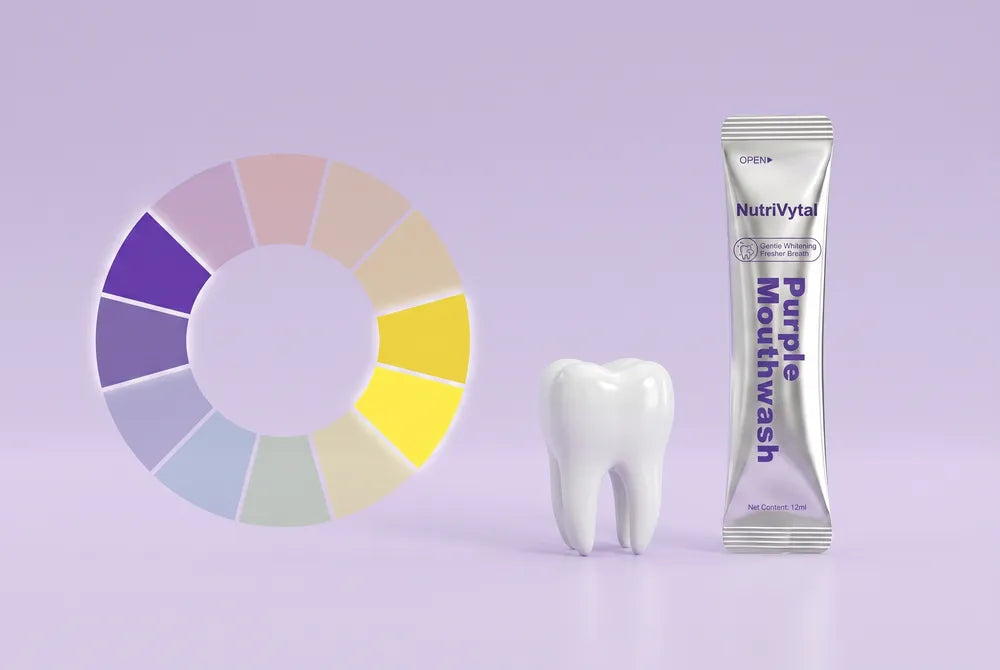
Applied to teeth, it works the same way. A purple rinse deposits a microscopically thin corrective layer over the enamel. The yellow tone is canceled, and the smile reads brighter in the mirror within about 30 seconds. Nothing is bleached. Nothing penetrates the enamel. It is optical, which is why it is instant and why it does not cause the sensitivity Carla had come to expect.
It is also why it works on surfaces bleach never could. Veneers, crowns, and bonding do not respond to peroxide at all, which is why whitening so often leaves dental work a different shade than the teeth around it. A color correction treats every surface the same.
What she actually uses
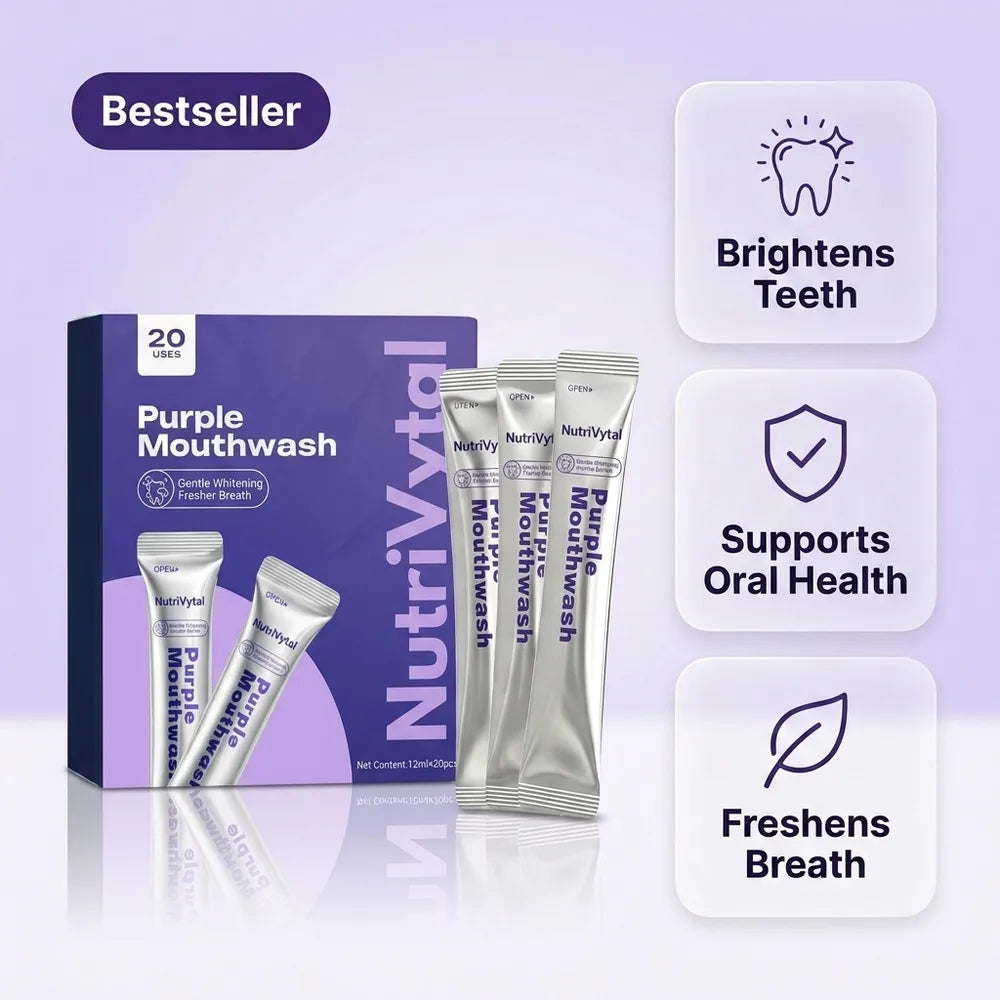
After trying 2 purple rinses that she describes as "grape-flavored water," Carla settled on NutriVytal Purple Mouthwash, a sachet-based rinse built around what the brand calls Color-Correct Technology.
The difference, she says, was pigment. "The cheap ones barely tinted anything. This one you could see work in the mirror before you even spit."
Each box holds 20 individually sealed 12ml sachets. The formula is peroxide-free, alcohol-free, and SLS-free, and alongside the color-correcting pigments it carries xylitol, hyaluronic acid for gum comfort, pyrophosphate to help fight tartar, and peppermint for fresh breath. It is formulated to be gentle on enamel, veneers, and dental work.
How she uses it
Brush as usual
A clean surface lets the pigment deposit evenly.
Tear and swish 30 seconds
1 sachet, no measuring. Work it across the front teeth.
Spit and go
The purple rinses away. The brightness stays for the hours that matter.

The photo that changed her mind

"Week 1, I caught myself smiling at the mirror on purpose," she said. "Week 3, someone took a group photo at work and I did not think about my mouth once. If you have never had this problem, that sounds like nothing. If you have, it is everything."
She is honest about the limits. The effect is optical and it fades between uses, so she swishes each morning and again before anything with a camera. It does not scrub off a real surface stain. "It is not a bleach and it does not pretend to be," she said. "That is why I trust it."
Why it is spreading

Carla's sister ordered a box the week she saw the photos. 2 coworkers followed. It tends to travel that way, one mirror at a time, because the result is visible in a single use rather than promised in week 3.
"Swished one sachet after brushing and my teeth looked brighter before I even spit it out. Coffee and wine had dulled my smile for years—now I get compliments and there's zero sensitivity."
What to know before you try it
No peroxide, no sting. There is nothing in the formula that bleaches, so there is nothing to cause whitening sensitivity.
It is cosmetic and temporary. It cancels yellow tone for the hours after you swish and fades between uses. Most people use 1 sachet each morning.
Works on dental work. Because it is optical, veneers, crowns, and bonding brighten evenly with natural teeth.
Subscribe & Save, cancel anytime. The first box is $29.99 with Subscribe & Save, against $39.99 one-time. Under $1.50 per use.
If you have been bleaching for years and your smile still photographs warm, you may never have had a stain problem at all. You may have a tone problem, and tone has a 30-second answer.