Why Your Teeth Still Look Yellow After Whitening: The 2-Layer Problem Nobody In The Aisle Explains
Healthy, well-brushed teeth can read yellow for a reason bleach was never designed to touch. Here is what is actually happening under the enamel, and what addresses it.

You brush. You floss. Your dentist says your teeth are healthy. And in every photo, your smile still reads warm, dull, a little yellow.
So you do what the aisle tells you to do. Strips. Gels. A light. Maybe a professional session. And the needle barely moves, if it moves at all.
This article is about why that happens. Not in vague terms, but mechanically, layer by layer. Because once you understand what is actually producing the yellow you see, the reason whitening keeps disappointing stops being a mystery, and the fix stops being a guess.
We spent several weeks reading the dental literature on tooth color, talking to people who color-correct for a living, and testing the purple rinses that have flooded the market. Here is what we found.
What a tooth is actually made of
Most people picture a tooth as a solid white block that gets dirty on the outside. It is not. A tooth is 2 layers, and the color you see comes from both of them together.
The outer layer is enamel. Enamel is hard, but it is not white. It is translucent, like frosted glass or a sheet of wax paper held up to a window. It has very little color of its own.
Underneath it is dentin. Dentin is a completely different material, and it is naturally yellow. Not from staining. Not from neglect. That is simply the color of the material, in almost every person alive, including people with flawless hygiene.

Put those 2 facts together and the whole picture changes. You have a naturally yellow core wrapped in a translucent shell. When light hits the tooth, it passes through the enamel, strikes the yellow dentin, and bounces back to your eye carrying that warmth with it.
A large part of what you see as "yellow teeth" is not sitting on the surface at all. It is the dentin, showing through from inside.
And this is why it gets worse with age no matter how careful you are. Enamel thins over the decades, from chewing, brushing, and acidic food and drink. The thinner the shell, the more of the yellow underneath shows through. Teeth genuinely do look more yellow at 45 than at 25, but for most people it is not because they collected more stain. It is because the shell hiding the yellow got thinner.
The 2 kinds of yellow, and why they need opposite fixes
Here is the distinction the whitening aisle never makes, and it is the most important sentence in this article.
There are 2 completely different reasons a tooth looks yellow, and they are not variations of the same problem. They are opposites.

The 1st kind is a stain. Pigment from coffee, black tea, red wine, cola, and tobacco settles on the outside of the enamel and builds up as a thin layer. It is a real, physical deposit sitting on top of the surface. And because it is on top, you can break it down and lift it off. That is exactly what peroxide does. For a genuine surface stain, whitening is the right tool, and it works.
The 2nd kind is tone. This is the yellow dentin showing through the translucent shell. There is no deposit. There is nothing sitting on the surface. The color is coming from inside the tooth.
Now the collision. Peroxide works by breaking down deposits on the surface. Tone is not a deposit on the surface. So peroxide has nothing to grab, nothing to oxidize, and it changes nothing. You can use the strongest kit on the shelf, for as long as you like, and the tone sits exactly where it was.
That is the trap most unhappy whiteners are in. They have tone. They are buying stain removers. A stronger stain remover is still a stain remover.
It also explains a pattern we heard again and again: the smile looks fine in the bathroom mirror and dull in every photo. A camera flash pushes warm tones harder than the eye does. It is reading the dentin through the enamel and exaggerating it. The stain never changed. The tone was always there. The flash simply made it impossible to ignore.
A 3-question self-check
1. Have you whitened honestly and consistently and seen little or no change? A real stain responds to bleach. If bleach did nothing, there was likely no deposit to remove.
2. Is the yellow fairly even across the whole tooth, rather than concentrated in lines near the gums or in the grooves? Even, all-over warmth is tone. Patchy darkening is more likely stain.
3. Are your teeth healthy and well-brushed, and still yellow? Then it is very unlikely to be hygiene or stain. It is the dentin showing through.
If you answered yes to those, no whitening product was ever going to fix your yellow. And now you know why.
Why bleaching the shell can backfire
There is an uncomfortable corner of this that deserves its own section, because a lot of long-term whiteners have felt it without being able to name it.
Remember that the enamel shell is the thing standing between you and the yellow. Thick enamel masks more dentin and reads lighter. Thin enamel lets more through and reads warmer.
Peroxide does not sit politely on the surface. It penetrates the enamel to reach pigment. Repeated, frequent whitening is associated with enamel that becomes temporarily more porous, more dehydrated, and more sensitive. That cold-water zing after a session is not a sign it is working. It is a sign the enamel is being acted on.
So follow the logic. The yellow is the dentin showing through the shell. The tool you are using to fight it is a chemical that stresses the shell, while doing nothing to the tone behind it. For a tone problem, aggressive bleaching is at best pointless, and at worst it is working on the wrong layer in the wrong direction.
To be fair: used occasionally on a genuine surface stain, with a dentist's guidance, peroxide is a legitimate tool. The problem is not that whitening exists. The problem is that it is sold to everyone, including the many people whose yellow it cannot reach.
The approach that actually addresses tone
If your yellow is tone, you do not need to remove anything, because there is nothing on the surface to remove. What you need is to change how that yellow reads to the eye. And there is a century-old field that does exactly that: color correction.
Every color has an opposite directly across from it on the color wheel. Lay a thin layer of the opposite over a color, and the 2 neutralize toward a neutral gray, which the eye reads as brighter, cleaner, and cooler. The opposite of yellow is purple.
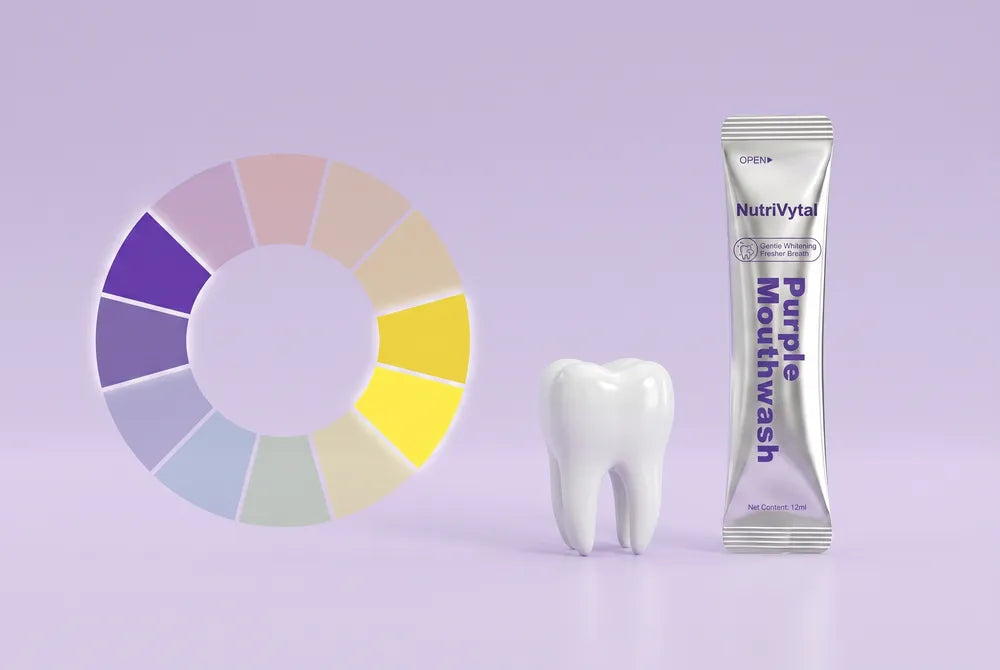
You already trust this principle in 3 places without thinking about it. Blondes and silver-haired people use purple shampoo to cancel brassy yellow. Makeup artists use lavender color-correctors to neutralize sallow, warm skin before foundation. And every phone camera has a white-balance setting that pushes a color cast toward its opposite.
Applied to teeth, a purple rinse deposits a microscopically thin corrective layer over the enamel. The yellow tone is canceled. Nothing is bleached. Nothing penetrates the shell. And because the effect is optical rather than chemical, it is immediate. There is no 3-week wait, because there is no chemical process to wait on.
It is also why it works on surfaces bleach cannot touch. Peroxide only acts on natural tooth structure, which is why whitening leaves veneers, crowns, and bonding a different shade than the teeth around them. A color correction treats every surface the same, so dental work brightens evenly with natural teeth.
Where NutriVytal fits
We tested 6 purple rinses for this piece. 4 of them were, functionally, purple-tinted water. They produced no visible shift in the mirror, because a corrector with too little pigment cannot deposit enough of the opposite color to cancel anything. That is a formulation failure, not a failure of the idea, and it is why some people try 1 and wrongly write the whole category off.
The one that behaved like a proper color-corrector was NutriVytal Purple Mouthwash, a sachet-based rinse built around what the brand calls Color-Correct Technology. It carried enough pigment to produce a clear shift in a single 30-second swish, and it rinsed clean with no purple left on the gums or tongue.
How we judged the 6 rinses
We used the same informal test on each one, on the same person, in the same bathroom light, with a phone photo before and after. 4 things decided it.
Does it visibly shift the tone in 1 pass? A corrector that does nothing on the 1st swish is not under-performing. It is under-pigmented, and more swishes will not fix that. 4 of the 6 failed here.
Does it rinse clean? A rinse that leaves purple on the tongue, gums, or the edges of the lips is depositing in the wrong places. 1 of the 6 did this badly enough to rule it out.
Is it peroxide-free? The entire point of a color correction is that it does not bleach. A purple rinse that also carries peroxide is 2 products fighting each other, and it brings back the sensitivity the category is supposed to avoid.
Is it a real mouthwash, or dye in water? If you are going to swish something daily, it should carry oral-care ingredients and not just pigment. Most of the cheaper rinses were, on inspection, little more than tinted water with flavoring.
This is not a laboratory study and we do not present it as one. It is the test anyone can run at home, and it is enough to separate a corrector from a novelty.

Pigment that actually corrects
Concentrated enough to cancel yellow tone in 1 pass, visible in the mirror in about 30 seconds.
Peroxide-free, alcohol-free, SLS-free
Nothing in the formula bleaches, so there is nothing to stress the enamel or cause whitening sensitivity.
Evens dental work
Because the effect is optical, veneers, crowns, and bonding brighten in step with natural teeth.
Oral-care ingredients, not just dye
Xylitol, hyaluronic acid for gum comfort, pyrophosphate to help fight tartar, and peppermint for fresh breath.
20 pre-measured sachets
12ml each. Tear, swish, spit. No bottle to measure, spill, or abandon under the sink.
What to realistically expect
The 1st swish. The tone shifts in the mirror before you spit. This is the whole point of an optical effect: it is instant, or it is not working.
The 1st week. Most people settle into 1 sachet each morning after brushing, plus 1 before anything with a camera. The closed-lip habit starts to fade on its own.
Ongoing. The effect is temporary. It cancels the tone for the hours after you swish and fades between uses, the way toned hair goes brassy again without purple shampoo. It is maintenance, not a one-time event.
What it will not do. It will not remove a genuine surface stain. That is still a job for brushing and hygiene visits. If you have both kinds of yellow, handle the stain the usual way and cancel the tone with the purple.
What customers report
"Swished one sachet after brushing and my teeth looked brighter before I even spit it out. Coffee and wine had dulled my smile for years—now I get compliments and there's zero sensitivity."

"I have two veneers from an old hockey injury, and every whitening product made the mismatch worse — my real teeth would lighten and the veneers wouldn't budge. This is the first thing that evens everything out, because it's not bleaching anything. I keep a sachet in my laptop bag for client days."

"After fifty, my teeth just kept getting warmer-looking no matter how much I brushed. My dentist told me it was the enamel thinning, not stains, and honestly nothing on the shelf addressed that until this. Thirty seconds in the morning and I look like I've had work done. My daughter started stealing my sachets."
The bottom line
There are 2 kinds of yellow. Bleach addresses 1 of them. For most healthy adults, the yellow they see is the other kind, and no strength of the wrong tool will ever reach it.
A color correction is not a trick and not a workaround. For a tone problem, it is the correct tool, the same way bleach is the correct tool for a stain. The difference is that one of them is sold to everyone, and the other one, until recently, was not sold for teeth at all.
Before you spend another dollar in the whitening aisle, run the self-check above. If your yellow is tone, you have been fighting the wrong fight, and the right one takes 30 seconds.
Before you order
Cosmetic and temporary. The effect is optical. It cancels yellow tone for the hours after use and fades between uses.
No peroxide, no sting. Safe on enamel, veneers, crowns, and bonding.
Subscribe & Save, cancel anytime. First box $29.99 with Subscribe & Save, against $39.99 one-time. Under $1.50 per use.